





We educate AI professionals who design systems that are explainable, transparent, and responsibly deployed.
Today, artificial intelligence is no longer enough if it simply “works.” The real challenge is to understand how and why AI systems make decisions, and to ensure those decisions are safe, ethical, and worthy of trust.
Throughout the program, students explore the methods and limitations of explainable and reliable AI, with particular focus on applications that influence people’s lives, health, and fundamental rights.
At Pázmány ITK, we see this as essential: trust in intelligent systems emerges only when their operation is both technically robust and genuinely understandable to humans.
A program designed to support multiple future paths.
Our goal is to equip students with hands-on skills for real industrial environments, while providing strong theoretical foundations for advanced academic and research-oriented careers.
Graduates are therefore well prepared to succeed in industry or to continue their studies in doctoral programs.
At Pázmány ITK, this balance is essential: artificial intelligence evolves rapidly, and long-term success belongs to those who can learn continuously, adapt confidently, and build on solid fundamentals.
At Pázmány ITK, innovation and responsibility go hand in hand.
AI today is more than a technical challenge – it’s a societal one. Our students master ethical AI, bias detection and mitigation, legal and data protection frameworks, and the demands of safety-critical applications.
This equips them to create AI solutions that are not only powerful but socially responsible and sustainable.
At Pázmány ITK, we believe that responsibly developed intelligence represents not only technological progress, but genuine societal value.
We build AI to work with humans – not replace them.
Our program emphasizes human cognition, perception, and decision-making.
Students learn to design AI that supports human decisions, can be personalized, and communicate their outcomes in a clear and interpretable manner.
This human-centered approach is vital in fields such as healthcare, education, public administration, and service industries.
At Pázmány ITK, we consider this fundamental: in most real-world applications, AI enhances human decision-making rather than substituting it.
We teach AI as a complete system, not merely as an isolated model.
Our program goes beyond training models. Students master the entire AI lifecycle: from data preparation and model design through validation, to deployment, operation, maintenance, and secure long-term use.
This systems-level approach ensures AI solutions are remain robust, reliable, and trustworthy in real-world environments.
At Pázmány ITK, we emphasize this because AI in practice is never just a model – it is a complex system that must be operated with responsibility.
Lecturer and researcher in machine learning, computer vision, and deep neural networks. Leads the UAV Vision Laboratory at Pázmány ITK, developing efficient AI algorithms for autonomous systems and real-time embedded vision applications. His work bridges academic research with practical implementations in robotics and perception.

Researcher in AI-based, real-time, and resource-efficient computer vision. Her work focuses on assistive technologies for people with visual impairments, optimizing machine learning models for both performance and accessibility. She applies cutting-edge AI in mobile vision applications and human-machine interaction.
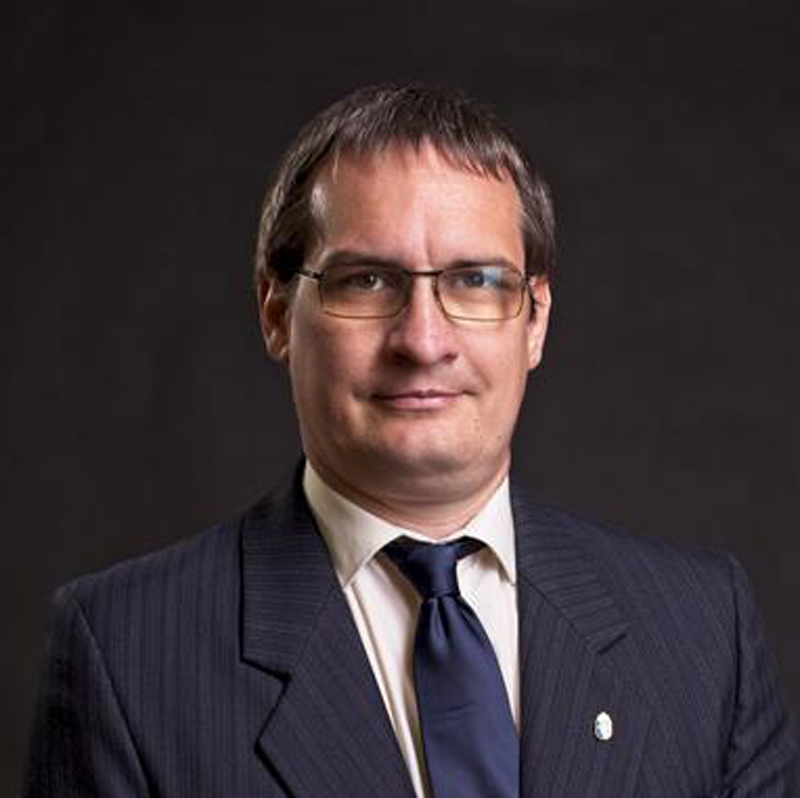
Lecturer and researcher in AI-driven data processing, algorithms, and programming. Specializes in sensor data analysis, pattern recognition, and resource-efficient AI methods for real-world applications. He also teaches core computing topics that underpin AI systems, including algorithms, programming languages, and data structures.
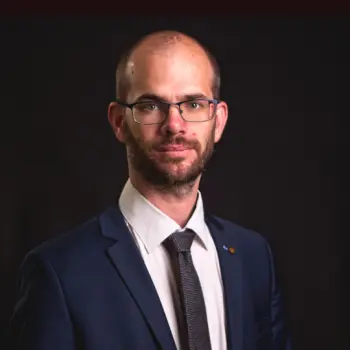
Researcher in parallel programming, scalable architectures, and performance-aware systems design, often in collaboration with international partners such as Oxford University. Leads the High-Performance Computing Research Group at Pázmány ITK, focusing on enabling efficient execution of large neural networks and AI workloads on parallel and distributed platforms.

One of the leaders of the Hungarian Bionic Vision Center and an expert in artificial intelligence. His research spans computer vision, sensor-proximal parallel processing, and learning under partial observability, addressing challenges in perception and decision-making for intelligent systems. He investigates how AI interprets and acts on sensory data in complex, uncertain environments such as robotics, autonomous navigation, and advanced perception systems.

Head of the Intelligent Sensing and Learning Laboratory at Pázmány ITK. His research bridges deep neural networks, computer vision, and image processing, advancing robust learning models for real-world perception tasks. He has contributed to projects on intelligent sensing systems, feature learning, and adaptive AI architectures, emphasizing both theoretical foundations and application-oriented innovation.